
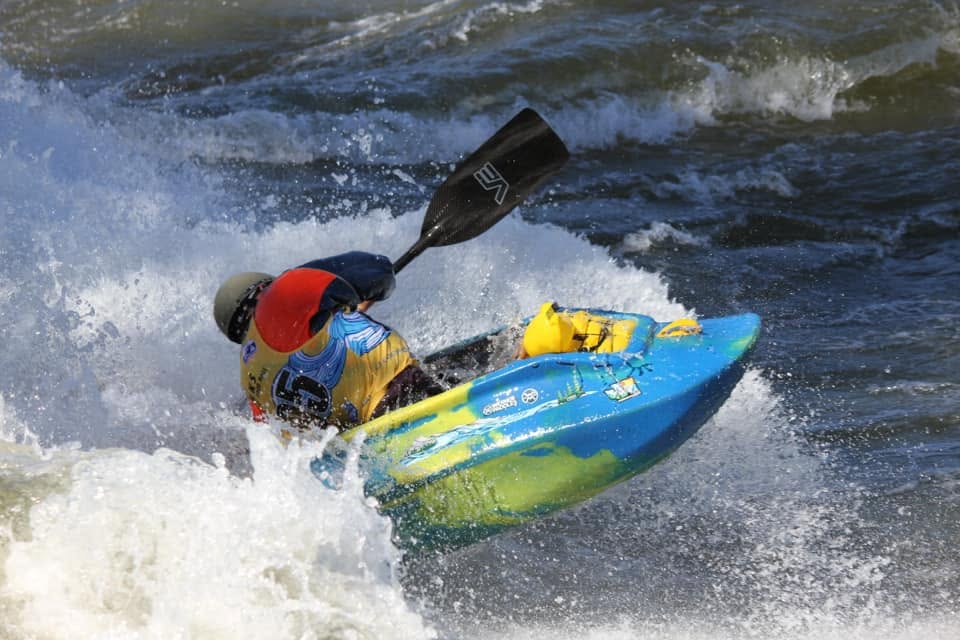
Introduction
I believe almost any individual trick that can be done in other disciplines could be done in an OC1. For me, that is a major part of the sport’s appeal. Anything can be done—even if it is a challenge—but not everything has been done yet. So that leaves the question: what is currently possible?
Basic moves: the spin
The spin is fairly self-explanatory: a 360-degree rotation to either the left or right, completed in one fluid motion. The move is also open to Clean and Style bonuses, which award the competitor extra points.
- Clean: completed with a single paddle stroke
- Super Clean: completed with no paddle stroke at all
- Style bonus: awarded at the judge’s discretion
Cartwheel
Much like a cartwheel performed on land, a cartwheel in the water goes end over end. Two ends count, but you can link three, four or keep going until you are as dizzy as you like. Cartwheels can go surprisingly well in an OC1. They may require a bit of muscle to get the ends moving, but once the momentum is in the right place, the ends follow.
Splitwheel and pirouette
A splitwheel changes the direction of a cartwheel. Like the cartwheel itself, it can require some muscle to move the boat, but it may actually be easier to score—provided you can rotate the boat on its nose. A pirouette is a controlled rotation performed while the boat is balanced vertically on one end.
More advanced moves: the loop
More advanced moves generally have an aerial component. The loop is a forward flip completed between 20 degrees left and 20 degrees right of straight. Although common in other disciplines, OC1 adds the challenge of a boat that can fill with water very quickly. It is therefore often chosen strategically when the canoe is at its lightest, usually near the beginning of a competition ride. A loop scores a minimum of 60 points before Air and Huge bonuses are added.
- Air: the boat is not touching the water at some point during the move
- Huge: an aerial move reaching the height or distance standard set before the competition
Space Godzilla and McNasty
Space Godzillas are also possible. A Space Godzilla is essentially a loop with a twist; the challenge is making sure it finishes straight and with air so that it scores. The McNasty is attempted more often: a 150-degree spin flowing smoothly into a front loop. Again, the move must finish straight to score.
Wave moves
This is where OC1 really gets the chance to shine. Most wave moves are possible, but the difference is that many can only be attempted once during a ride. That adds to the skill required and, in my opinion, makes every scored move mean more. You can still produce massive moves in an OC1. The boats are generally quite easy to get surfing—the problem can be getting them to stop surfing.
The right feature
OC1 favours big, deep features. That is a fact. Bigger features can make bigger tricks possible and, just as importantly, they can be a lot more fun.
Feature entry
How you enter a feature can be vital to whether you are able to score your tricks. Dropping into a wave or hole can make it easier to reach the part of the feature where you want to perform. You can also attempt an entry move for quick points, but this may fill the boat halfway with water and make aerial moves harder because of the extra weight. Coming onto the feature from below has its own advantage: it can make it easier to get established on the feature and ensure you have the chance to attempt your tricks.
Progression
When first starting in OC1—as with kayaking generally—it is easy to get carried away by what you think you should be capable of doing, or what you think should be easy. Once you get into the grand old mix of things, it can turn out very differently, and it is easy to become disheartened or demotivated. The most important thing is to find enjoyment in your sessions. Messing around with silly tricks with your friends can be worth far more than taking every session too seriously. After all, that is the essence of freestyle kayaking.
Progress at your own pace, paddle with good people and keep it fun.