
The rule that keeps OC1 open
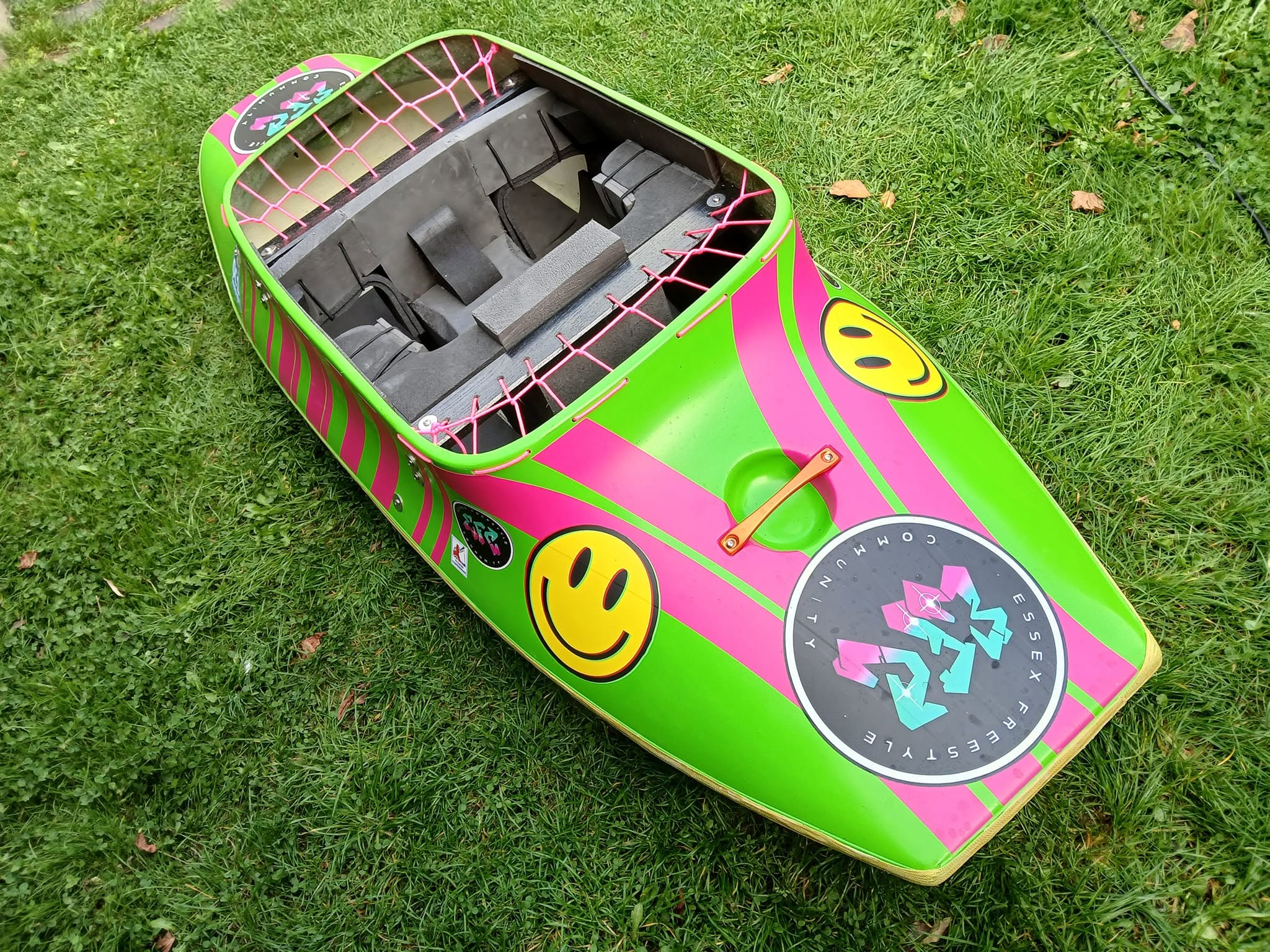
ICF Rule 3.3 defines the competition OC1 as more than a decked kayak fitted with a kneeling saddle. The athlete must kneel and use a single-bladed paddle, while the canoe must retain a genuinely open hull. These requirements act as a design boundary: builders can pursue short, aerial boats, but they must still preserve the identity and practical consequences of an open canoe.
The first sections explain the 2025 rules and their design legacy. From 2027, the minimum water capacity falls to 30 litres; the new requirements and their possible effects are explained below.
The four defining requirements under the 2025 rules
Under the 2025 rules, a competition OC1 must pass four closely related tests with its flotation fully inflated and in place. This is the framework that shaped the boats discussed here.
- Water retention: the boat must be able to hold at least 40 litres of water with the athlete kneeling inside
- Open depth: the open part of the boat must be at least 37.5 cm deep for a continuous length of 80 cm
- Open surface: the overall open area must be at least 3,800 cm²
- End buoyancy: buoyancy in the ends must be inflatable; rigid bulkheads are not permitted
Managing the water weight
The 40-litre test forces designers to accept a substantial open volume around the paddler. During a ride, water entering that space normally adds weight and makes aerial moves harder, so modern hulls are shaped to control where it collects and to shed it quickly. A compact central well keeps the required volume close to the paddler, while low ends, strong rocker and an efficient drainage path help the boat recover between moves.
How water behaves in a live feature depends on the hull, outfitting, paddler and move. The rules specify capacity—not a single correct design solution.
High central walls and sharp step-downs
To achieve the required depth over 80 cm without carrying traditional canoe height along the whole hull, many modern designs divide the profile into distinct zones.
- Centre: tall, relatively straight sidewalls create the open cockpit and the depth needed for compliance
- Ends: beyond the measured central zone, the sheer line can fall rapidly into lower-volume bow and stern shapes
- Freestyle effect: the centre remains recognisably open while the tapered ends initiate more readily for cartwheels, loops and other vertical moves
Precision inflatable flotation
The large cockpit opening leaves the bow and stern as the principal areas for displacement and recovery. Because the ICF requires inflatable end buoyancy and prohibits bulkheads, designers and outfitters use carefully shaped airbags that occupy the available end volume without intruding into the legal opening.
- Dry end volume helps a submerged bow or stern return towards the surface
- Accurate bag fit reduces unnecessary free water in the ends
- The flotation must remain fully inflated and in place when the 40-litre test is carried out
The wide planing hull
Shortening a canoe while retaining a large open area naturally encourages substantial width through the middle. Modern designers turn that constraint into a performance feature with broad planing surfaces, pronounced flare and clean release edges.
- The wide footprint creates stability around the kneeling paddler
- A planing surface generates dynamic lift and lets the boat surf and spin more freely
- Flared sides help provide cockpit volume while keeping the waterline and ends responsive
These hull effects are an interpretation of how designers respond to the dimensional rules; the ICF does not prescribe a particular width, rocker line or hull profile.
Traditional and modern design compared
The rules did not dictate a single boat, but they helped focus modern OC1 design on a recognisable combination of an open central cockpit and highly specialised ends.
- Water management — traditional: high gunwales aimed to keep water out; modern: compact open volume and rapid drainage manage unavoidable water
- Sidewall profile — traditional: long and relatively uniform; modern: a defined central cockpit with pronounced step-downs
- Flotation — traditional: general end airbags; modern: carefully fitted inflatable bags that preserve the measured opening
- Hull shape — traditional: longer and narrower for tracking; modern: short, wide planing hulls for lift, release and rotation
2027: the move from 40 litres to 30 litres
The Paddle Worldwide Canoe Freestyle Official Rules Summary, effective from 2027 and beyond, reduces the minimum water capacity of an OC1 from 40 litres to 30 litres. This changes the capacity test, not the requirement to paddle a genuinely open canoe. The paddler still kneels and uses a single blade.
- Minimum retained-water capacity: 30 litres instead of 40 litres
- Open depth: 37.5 cm over a continuous length of 80 cm
- Minimum open surface area: 3,800 cm²
- The retained-water requirement describes what the canoe must be able to hold; it does not mean paddlers must carry 30 litres throughout a ride
The 2027 update is based on the supplied Paddle Worldwide official rules summary, linked below. The dimensional requirements remain part of the design challenge; the reduced capacity does not automatically permit a smaller opening or lower cockpit.
What could this mean for the next generation of boats?
Ten litres less required capacity gives designers more freedom in how they arrange the usable space around the paddler. It does not prescribe a new hull or guarantee an improvement. Builders will need to explore that freedom through prototypes, on-water testing and competition.
- Cockpit and outfitting: designers may refine the internal well, saddle and permitted flotation arrangement to limit unnecessary water while preserving the legal opening and depth
- Drainage: better escape paths and fewer pockets that trap water could help the canoe recover between moves
- Weight distribution: keeping free water close to the paddler may make changes in balance more predictable
- Fit and response: a wider range of outfitting choices could make compliant boats easier for paddlers of different sizes to control
These are design possibilities, not claims made by the rules bulletin. A 10-litre reduction in minimum capacity is not an automatic 10 kg saving in a paddling session: the amount of water aboard depends on the boat, flotation, feature and move.
Women’s OC1: a new reason to design for more paddlers
From 2027, OC1 is divided into Men’s OC1 (MOC1) and Women’s OC1 (WOC1), with up to two places per gender for each national federation. Men and women share heats and finals on the water, while separate standings are extracted after each round. This creates a clearer competitive pathway for women in open canoe freestyle.
- The opportunity extends beyond a new results table: more paddlers can help drive demand for different fits, saddle positions and responsive outfitting
- A lower water-capacity minimum may help builders make boats more manageable for lighter paddlers, including women
- Boat choice should respond to the individual’s size, strength, reach and paddling style; there is no single ideal shape for all women or all men
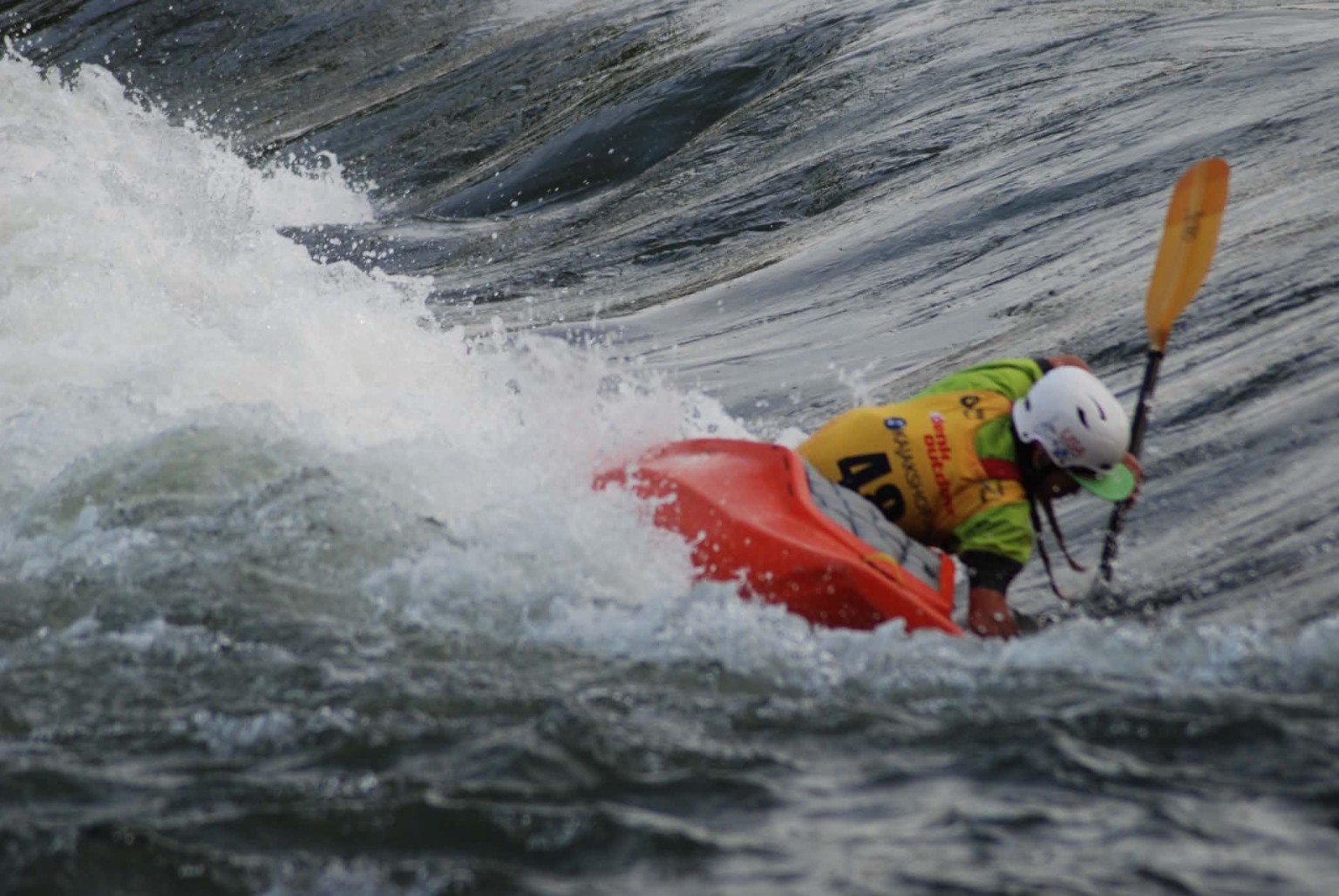
Holly Reppert’s participation at Plattling in 2025 is part of this changing story. The next step is to turn a place in the rulebook into opportunities to try boats, practise and compete.
What about existing OC1s?
The new rule is a lower minimum, not a requirement to hold exactly 30 litres. A canoe that can pass the old 40-litre capacity test also exceeds the new capacity minimum, but it must still satisfy every other applicable equipment and safety requirement. There is no reason to assume a new boat is needed solely because this minimum changes.
Future OC1 design will remain a balance of open-canoe identity, fit, buoyancy, drainage and freestyle performance. The strongest outcome would be more choice and more paddlers enjoying the class—not simply a smaller number on a measurement sheet.
A living design challenge
Every modern OC1 is a negotiation between the rulebook and the river. It must be open enough to remain unmistakably a canoe, yet light, short and responsive enough to perform contemporary freestyle moves. That tension is exactly what gives the class its distinctive boats—and keeps designers experimenting.
Official rules and background
Read the supplied 2027 rules summary alongside the earlier ICF documents. The earlier rulebooks explain the design history; the 2027 summary introduces the 30-litre minimum, gender categories and quotas.